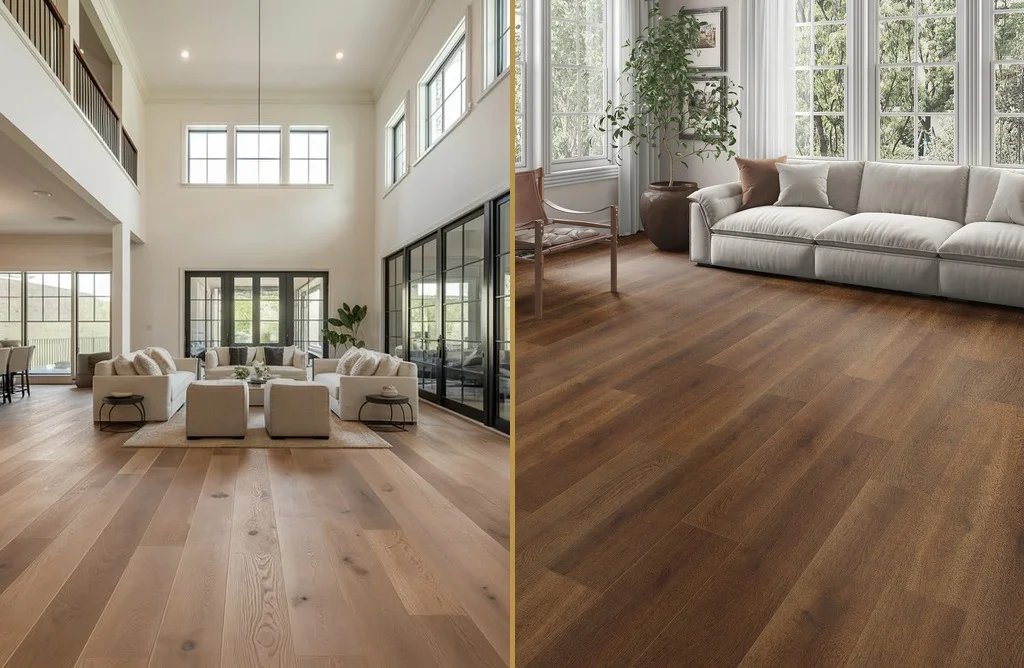
Choosing between hardwood vs laminate flooring comes down to three things that matter most over the life of the floor: how long it lasts, how natural it looks, and what it’s actually worth to you years down the road. Both materials have improved significantly in recent years, which makes the decision less obvious than it used to be.
This guide breaks down the real differences in durability, appearance, and long-term value, plus the costs and mistakes homeowners run into when making this choice.
What Is Hardwood Flooring?
Hardwood flooring is made from solid planks of natural wood, such as oak, maple, hickory, or walnut, milled directly from timber. Each plank is a single piece of wood from top to bottom, which is what allows it to be sanded and refinished multiple times over its life.
There’s an important distinction many homeowners miss: solid hardwood versus engineered hardwood. Solid hardwood is exactly what it sounds like, one piece of wood throughout. Engineered hardwood has a thinner layer of real wood veneer bonded over layers of plywood or high-density fiberboard. Engineered hardwood is more stable in humidity and temperature swings and can be installed in more locations, including some basements, while solid hardwood performs best in stable, dry environments.
What Is Laminate Flooring?
Laminate flooring is a synthetic product built in layers: a high-density fiberboard core, a printed image layer that mimics wood grain, and a hard, clear wear layer, typically melamine, on top that protects the surface from scratches and wear.
Laminate durability is measured using the AC rating system, which ranges from AC1 to AC5. AC3 is the standard rating for residential use, while AC4 and AC5 are built for heavier commercial or high-traffic use. Checking the AC rating before buying is one of the simplest ways to know what a specific laminate product can actually handle.
Hardwood vs Laminate Flooring: Key Differences at a Glance
| Feature | Hardwood Flooring | Laminate Flooring |
|---|---|---|
| Material | Solid or engineered real wood | Synthetic layers with printed wood image |
| Lifespan | 30 to 100+ years with refinishing | 15 to 25 years |
| Refinishable | Yes, 4 to 7 times depending on thickness | No |
| Water Resistance | Moderate, engineered better than solid | Varies, some modern lines are water-resistant |
| Scratch Resistance | Moderate, shows wear over time | Strong, protective wear layer |
| Installation | Nailed, glued, or floating | Click-lock, floating, DIY-friendly |
| Cost Range | Higher | Lower |
| Resale Value Impact | Strong, often a selling point | Neutral to modest |
Durability: Which Flooring Lasts Longer?
This is where the two materials diverge the most, and the answer depends on what “durability” means to you.
Hardwood’s durability comes from repairability.
A solid hardwood floor can typically be sanded and refinished 4 to 7 times over its life, depending on the thickness of the wearable wood layer. That’s what allows a well-maintained hardwood floor to last 30, 50, or even 100+ years, even though the surface will show scratches and dents over time from daily use.
Laminate’s durability comes from its wear layer.
The melamine surface on laminate resists scratches from pets’ nails and everyday foot traffic more effectively than a bare hardwood surface, which is a real advantage in households with dogs or cats. However, once that wear layer is damaged or water gets underneath it, there’s no fixing it. A water leak that reaches the fiberboard core will cause it to swell and warp, and the damaged planks need to be replaced entirely rather than repaired.
Laminate’s AC rating tells you what to expect.
An AC3-rated laminate is built for normal residential foot traffic. If you have a high-traffic entryway or a home with several kids and pets, looking for AC4 gives extra durability margin, even in a residential setting.
Look: Which Flooring Looks More Natural?
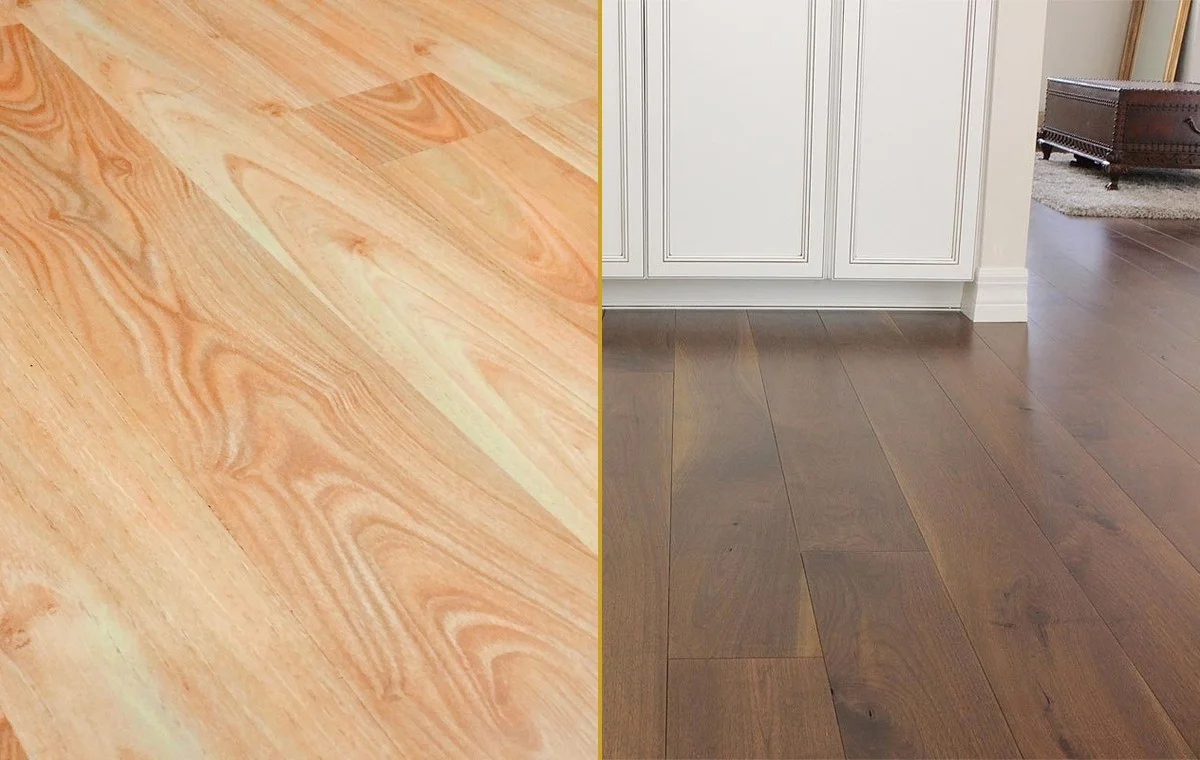
Hardwood has an obvious advantage here simply because it is real wood. Natural grain variation, knots, and color shifts from plank to plank give hardwood floors a depth and texture that’s difficult to fully replicate.
That said, laminate has closed the gap significantly. Premium laminate lines now use embossed-in-register texturing, where the surface texture is aligned with the printed wood grain pattern underneath, so the floor doesn’t just look like wood in a photo, it feels similar underfoot too. At a glance, and sometimes even up close, distinguishing high-end laminate from real hardwood has become genuinely difficult.
Where hardwood still wins decisively is in long-term appearance changes. Wood ages and develops a natural patina over years, which many homeowners find appealing. Laminate’s printed pattern looks the same on day one and day ten years later, for better or worse depending on your preference.
Long-Term Value: Which Flooring Is Worth the Investment?
Hardwood typically adds more resale value.
Real estate professionals and buyers consistently associate hardwood flooring with higher home value, and it’s often listed as a specific selling point in property listings. Laminate is viewed neutrally by most buyers, it rarely hurts a sale, but it doesn’t add the same premium that hardwood does.
Hardwood’s total cost of ownership can be lower than expected.
Because it can be refinished multiple times instead of replaced, a hardwood floor installed once can outlast two or three laminate installations over the same time period, even though the upfront cost is higher.
Laminate wins on immediate value for budget-conscious projects.
If you’re flooring a rental property, a room you plan to update again in 10 to 15 years, or a space where budget matters more than resale premium, laminate delivers a good-looking floor for meaningfully less money upfront.
Cleaning and Maintenance
Hardwood should be cleaned with a dry or barely damp mop and a wood-specific cleaner. Standing water and wet mopping are two of the fastest ways to damage a hardwood floor, since moisture can seep between the boards and cause warping over time.
Laminate is generally easier to maintain day to day. Most laminate can handle a damp mop without issue, since the wear layer is more water-resistant than exposed wood, though standing water should still be avoided and wiped up promptly, especially near seams.
Hardwood vs Laminate Flooring: Pros and Cons
Hardwood Pros
- Can be refinished multiple times, extending usable life for decades
- Adds measurable resale value
- Ages with a natural patina many buyers find appealing
- Available in solid or engineered form for different installation needs
Hardwood Cons
- Higher upfront cost
- More vulnerable to scratches and water damage on the surface
- Solid hardwood isn’t recommended for basements or high-humidity rooms
Laminate Pros
- More affordable upfront
- Strong scratch resistance from the wear layer
- DIY-friendly click-lock installation
- Modern lines offer realistic wood-look textures
Laminate Cons
- Cannot be refinished or repaired if damaged
- Water damage to the core is permanent
- Adds less resale value than hardwood
- Can sound hollow without proper underlayment
Hardwood vs Laminate Flooring: Cost Comparison 2026
Prices below are estimated ranges based on current market data, including standard installation. Actual cost depends on species, brand, and region. Contact Carlton Doors for accurate pricing on your specific project.
| Flooring Type | Estimated Cost Per Sq. Ft., Installed (USD) |
|---|---|
| Laminate, AC3 (standard) | $3 – $6 |
| Laminate, AC4/AC5 (heavy-duty) | $5 – $8 |
| Engineered hardwood | $6 – $12 |
| Solid hardwood, standard species (oak) | $8 – $15 |
| Solid hardwood, premium species (walnut) | $12 – $22 |
A full room installation (roughly 300 sq. ft.) typically runs $900 to $6,600 depending on material choice. Canadian pricing in Ontario and British Columbia generally runs 10 to 20 percent higher than equivalent US pricing when converted to CAD. Refinishing an existing hardwood floor instead of replacing it typically costs $3 to $8 per square foot, which is often the more economical choice compared to a full laminate replacement over the same timeframe.
How to Choose Between Hardwood vs Laminate Flooring
Step 1: Decide how long you plan to stay.
If you’re settling in long-term, hardwood’s refinishing potential and resale value make it the stronger investment. If you plan to move or renovate again within 10 to 15 years, laminate delivers good value without overpaying for longevity you won’t use.
Step 2: Check the room’s moisture exposure.
Basements and moisture-prone areas rule out solid hardwood. Engineered hardwood or a water-resistant laminate line are safer choices in those spaces.
Step 3: Factor in pets and foot traffic.
Laminate’s wear layer resists scratches from pet nails better than hardwood. If durability against daily wear is the top priority, look for at least an AC4-rated laminate.
Step 4: Set your budget honestly.
Solid hardwood in premium species costs significantly more than laminate. Know your number before falling in love with a specific wood species.
Step 5: Decide who’s doing the installation.
Laminate’s click-lock system is genuinely DIY-friendly. Hardwood installation, especially nail-down or glue-down solid wood, is best left to a professional.
Who Should Buy What: The Final Verdict
Choose laminate if:
your budget is limited, you have pets or kids putting the floor through daily wear, you want a DIY-friendly installation, or you’re flooring a space you plan to update again within 15 years.
Choose hardwood if:
you’re investing in a long-term home, resale value matters to you, you want a floor that can be refinished instead of replaced, or you’re drawn to the natural look and feel that only real wood provides.
Common Mistakes to Avoid
Choosing laminate for a wet area without checking water resistance.
Not all laminate is created equal. Standard AC3 laminate without a water-resistant core can still be damaged by spills and humidity, especially in bathrooms or laundry rooms.
Installing solid hardwood in a basement.
Below-grade moisture is one of the most common causes of hardwood floor failure. Engineered hardwood or laminate are the safer choices in below-grade spaces.
Skipping underlayment with laminate.
A cheap or missing underlayment is the main reason laminate floors sound hollow or “clicky” underfoot. A quality foam or cork underlayment solves this for a relatively small added cost.
Wet mopping hardwood floors regularly.
Standing water and wet mops are two of the fastest ways to damage hardwood over time. A dry or barely damp mop with a wood-specific cleaner protects the finish far better.
Not checking the AC rating before buying laminate for a busy household.
A standard AC3 laminate in a high-traffic entryway with kids and pets will show wear faster than an AC4 or AC5 product built for that level of use.
Hardwood vs Laminate Flooring: Summary Comparison
| Feature | Hardwood | Laminate |
|---|---|---|
| Lifespan | 30–100+ years with refinishing | 15–25 years |
| Repairable | Yes | No |
| Resale Value | Strong | Neutral to modest |
| Upfront Cost | Higher | Lower |
| Scratch Resistance | Moderate | Strong |
| Best For | Long-term homeowners, resale focus | Budget projects, high-traffic households |
Frequently Asked Questions
Which is better for resale value: hardwood or laminate flooring?
Hardwood flooring generally adds more resale value and is often highlighted as a selling point in property listings. Laminate is viewed neutrally by most buyers and typically doesn’t add the same value premium.
Can laminate flooring resist scratches from pets better than hardwood?
Yes. Laminate has a protective melamine wear layer that generally resists scratches from pet nails and daily foot traffic better than exposed hardwood, which can show surface scratches over time.
How long does laminate flooring last compared to hardwood?
Laminate typically lasts 15 to 25 years. Solid hardwood can last 30 to 100 or more years because it can be sanded and refinished multiple times instead of being replaced.
Is laminate flooring cheaper to install than hardwood?
Yes. Laminate material costs less, and its click-lock installation system is DIY-friendly, which can also save on labor costs compared to professionally installed hardwood.
Can water-damaged laminate flooring be repaired?
Generally, no. If water reaches the fiberboard core, it swells and warps permanently. Damaged laminate planks typically need to be replaced rather than repaired.
Can hardwood flooring be installed in a basement?
Solid hardwood isn’t recommended for basements due to moisture exposure. Engineered hardwood or a water-resistant laminate are safer choices for below-grade spaces.
Does laminate flooring look like real wood?
Modern premium laminate uses embossed texturing aligned with the printed wood grain, making it genuinely difficult to distinguish from real hardwood at a glance, though hardwood still shows more natural variation up close.
How many times can hardwood floors be sanded and refinished?
Solid hardwood floors can typically be sanded and refinished 4 to 7 times, depending on the thickness of the wood above the tongue and groove.
What is an AC rating for laminate flooring, and why does it matter?
The AC rating measures laminate durability on a scale of AC1 to AC5. AC3 is standard for residential use, while AC4 and AC5 handle heavier traffic. Checking this rating helps match the product to how much wear your space will see.
Is laminate flooring noisy to walk on?
It can be if installed without proper underlayment. A quality foam or cork underlayment reduces the hollow, clicky sound that laminate is sometimes known for.
Ready to Choose Your Flooring?
Carlton Doors supplies hardwood and laminate flooring for homeowners and builders across the USA and Canada. Whether you want the long-term value of hardwood or the budget-friendly durability of laminate, the Carlton Doors team can help you find the right material, style, and finish for your home and budget.
Get in touch for product availability, accurate pricing, and guidance on your flooring project.
Contact Carlton Doors
USA:
Phone:+1 (562) 545-1118
Email:info@carltondoors.com
Address: 16448 Manning Way, Cerritos, CA 90703
Canada:
Phone: +1 (437) 238-9088
Address: 2425 Meadowpine Blvd, Unit 2, Mississauga, ON L5N 6L7
Disclaimer: This article is for informational purposes only. Flooring styles, pricing, and availability may vary by region and supplier. All prices listed are estimated ranges and are subject to change. Carlton Doors recommends consulting with a professional before making final purchasing decisions.
Carlton Doors USA & Canada