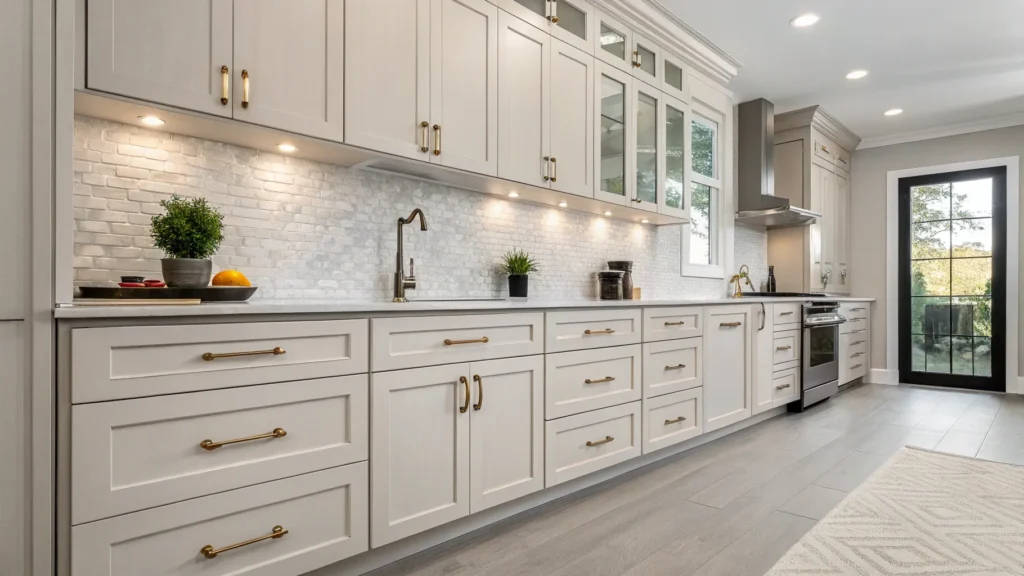
Knowing how to pick cabinet hardware is one of those small decisions that changes how an entire kitchen reads. Cabinets can be perfect the right color, the right door style, the right layout and still feel unfinished if the knobs and pulls don’t match the room. Hardware is the jewelry of a kitchen. Get it right and the whole space feels intentional. Get it wrong and even expensive cabinets look like an afterthought.
This guide walks through how to pick cabinet hardware step by step: matching hardware to your cabinet style, choosing between knobs and pulls, picking a finish that will still look good in ten years, sizing hardware correctly, and avoiding the mistakes that show up in almost every kitchen remodel.
What Counts as Cabinet Hardware?
Cabinet hardware covers everything you touch to open a cabinet or drawer: knobs, pulls, bin pulls, cup pulls, and integrated or edge-profile handles. It also includes hinges, though most homeowners focus on the visible pieces since those are what set the tone for the room.
Three main categories show up in almost every kitchen:
- Knobs – A single round, square, or oval piece mounted with one screw. Common on cabinet doors.
- Pulls (bar pulls) – A longer bar mounted with two screws. Common on drawers and increasingly common on doors too.
- Cup pulls / bin pulls – A curved or recessed pull, often used on drawers in farmhouse and traditional kitchens.
None of these is objectively better. The right choice depends on the cabinet style, the drawer size, and how the kitchen is used day to day.
Why Cabinet Hardware Matters More Than People Expect
Homeowners spend weeks picking cabinet color and months picking countertops, then grab hardware in the last ten minutes of a showroom visit. That’s backwards. Hardware is handled dozens of times a day, sits at eye level, and catches light differently than paint or wood. A kitchen with strong cabinets and mismatched hardware still looks unfinished. A kitchen with simple cabinets and well-chosen hardware often looks more expensive than it actually is.
Hardware also affects resale. Buyers notice finish consistency without knowing exactly why a kitchen feels “put together.” Mixed metals done on purpose read as designed. Mixed metals done by accident read as neglected.
How to Pick Cabinet Hardware for Your Cabinet Style
Different cabinet door styles pair better with certain hardware shapes. This is the first filter to apply before you look at finish or price.
| Cabinet Style | Best Hardware Type | Why It Works |
|---|---|---|
| Shaker | Cup pulls, bin pulls, bar pulls, knobs | Frame detail suits both traditional and simple hardware |
| Flat panel / slab | Long bar pulls, integrated handles | Clean surface needs a linear, minimal shape |
| Raised panel | Ornate knobs, traditional pulls | Detailed doors suit detailed hardware |
| Two-tone kitchens | Consistent hardware across both colors | Keeps the color transition looking planned |
| Farmhouse | Cup pulls, black iron knobs | Matches the worn, functional aesthetic |
If your kitchen already leans traditional, ornate hardware won’t clash. If it leans modern, a busy or antique-style pull will fight the cabinets instead of complementing them. When in doubt, simpler wins plain hardware ages better than trend-driven shapes.
Knobs vs Pulls: Which Should You Use?
This is the single most common question homeowners ask once they start shopping. The honest answer is that most kitchens use both.
| Feature | Knobs | Pulls |
|---|---|---|
| Best For | Upper cabinet doors | Drawers, tall doors |
| Grip | One or two fingers | Full hand |
| Install | Single screw | Two screws |
| Cost | Generally lower per piece | Slightly higher per piece |
| Look | Traditional or transitional | Modern or transitional |
| Practicality | Fine for light daily use | Easier to open with full hands |
A common and practical split: knobs on cabinet doors, pulls on drawers. It’s not a rule, but it works in the majority of kitchens because drawers get opened with a full hand and doors don’t.
How to Pick Cabinet Hardware Finishes That Last
Finish is where most kitchens either come together or fall apart. The goal isn’t to chase the trendiest metal it’s to pick a finish that matches your other fixtures and won’t look dated in five years.
| Finish | Best Paired With | Longevity |
|---|---|---|
| Matte Black | White, navy, sage cabinets | Strong, currently dominant |
| Brushed Brass / Gold | Warm white, navy, forest green | Strong, classic revival |
| Brushed Nickel | Grey, white, transitional kitchens | Very stable, rarely dates |
| Chrome | Modern, high-gloss kitchens | Cooling off, best in modern-only spaces |
| Oil-Rubbed Bronze | Traditional, farmhouse kitchens | Steady, long-standing choice |
A simple way to check your finish choice: look at your faucet, light fixtures, and any exposed appliance trim. Hardware doesn’t need to match those exactly, but it should belong to the same metal family warm tones with warm tones, cool tones with cool tones.
Step-by-Step: How to Pick Cabinet Hardware for Your Kitchen
Step 1: Confirm your cabinet style first.
Shaker, flat panel, or raised panel each pull toward a different hardware shape. Start here before looking at finishes.
Step 2: Choose knobs, pulls, or a mix.
Decide based on drawer size and daily use, not just looks. Wide drawers almost always need pulls for a proper grip.
Step 3: Pick one finish family and stay with it.
Matte black, brass, and nickel are the three safest long-term choices. Pick one and use it throughout the kitchen unless you’re intentionally mixing metals with a plan.
Step 4: Measure before you order.
Standard cabinet pull sizes run from 3 inches to 12 inches. Drawers under 24 inches wide typically use a 3–5 inch pull. Wider drawers look better with a longer pull, usually 6–10 inches.
Step 5: Order one sample piece first.
Photos and finishes look different under kitchen lighting than they do online. A single sample piece, held against your actual cabinet door, prevents an expensive reorder.
Cabinet Hardware Sizing Guide
| Cabinet or Drawer Width | Recommended Pull Length |
|---|---|
| Under 18 inches | 3–4 inch pull or knob |
| 18–24 inches | 4–6 inch pull |
| 24–36 inches | 6–8 inch pull |
| Over 36 inches | 8–12 inch pull |
For doors, standard placement is 2.5 to 3 inches from the corner of the door, centered vertically or aligned with the rail. For drawers, hardware is typically centered both vertically and horizontally unless the drawer is unusually wide, in which case two pulls may be used instead of one.
Cabinet Hardware Cost Guide 2026
Prices below are estimated ranges based on current market data. Actual pricing depends on material, finish, brand, and supplier. Contact Carlton Doors for accurate pricing on your specific project.
| Hardware Type | Estimated Price Per Piece (USD) |
|---|---|
| Basic knobs (zinc/steel) | $2 – $8 |
| Mid-range knobs (brass, nickel) | $6 – $15 |
| Basic bar pulls | $4 – $12 |
| Mid-range bar pulls | $10 – $25 |
| Premium/designer pulls | $25 – $60 |
| Cup and bin pulls | $6 – $20 |
A typical kitchen uses 25 to 40 pieces of hardware total. A mid-range full kitchen hardware order in the USA generally runs between $250 and $900. Canadian pricing in Ontario and British Columbia tends to run 10 to 20 percent higher than equivalent US pricing when converted to CAD.
Common Mistakes to Avoid When Picking Cabinet Hardware
Mixing too many metals without a plan. One accent metal alongside a primary finish can look designed. Three or four different metals across one kitchen usually reads as unplanned.
Choosing hardware before the cabinet finish is final. Paint and stain samples can shift under different lighting. Lock in the cabinet color first, then hold hardware samples against the finished swatch.
Ignoring drawer width. A pull that’s too short on a wide drawer looks like an afterthought and is genuinely harder to use. Match the pull length to the drawer, not just the style.
Buying all hardware from photos alone. Finish and scale are difficult to judge from a screen. Order one sample piece before committing to a full set.
Overlooking hinges. Soft-close hinges and exposed hinge finishes matter more than most homeowners expect, especially on inset cabinet doors where the hinge is visible.
Cabinet Hardware vs No Hardware (Integrated Pulls)
| Feature | Traditional Hardware | Integrated/Edge Pulls |
|---|---|---|
| Look | Classic to modern, wide range | Ultra-minimal, modern only |
| Cost | Lower overall | Higher, requires special door milling |
| Cleaning | Easy | Very easy, no protrusions |
| Best For | Most kitchen styles | High-end contemporary kitchens |
| Resale Appeal | Broad | Niche, style-dependent |
Integrated pulls look sleek but commit the kitchen fully to a modern direction and typically cost more due to the door milling required. For most homeowners, standard hardware offers more flexibility and easier future updates.
Frequently Asked Questions
How do I pick cabinet hardware that matches my kitchen style?
Start with your cabinet door style. Shaker and raised panel cabinets suit traditional shapes like cup pulls and knobs, while flat panel cabinets suit long, simple bar pulls. Match the finish to your existing faucet and light fixtures to keep the room consistent.
What is the easiest way to pick cabinet hardware for a whole kitchen?
Pick one finish family first, then decide between knobs and pulls based on drawer size. Order a single sample piece and hold it against your actual cabinets before buying the full set.
Should cabinet knobs and pulls match exactly?
They don’t need to be identical, but they should share a finish family. A common approach is one style and finish for knobs on doors and a matching finish for pulls on drawers.
What size cabinet pull should I buy?
Drawers under 24 inches wide typically use a 4–6 inch pull. Wider drawers look better with an 8–12 inch pull. Doors usually take a knob or a shorter 3–5 inch pull placed near the corner.
Is matte black or brass better for cabinet hardware in 2026?
Both remain strong choices. Matte black suits white, navy, and sage cabinets and works well in modern and transitional kitchens. Brass pairs well with warm cabinet colors and has held steady popularity for several years, making it a safe long-term pick.
Can I mix cabinet hardware finishes?
Yes, in moderation. One primary finish with a single accent metal, such as black hardware with brass cabinet handles on an island, can look intentional. More than two finishes in one kitchen usually looks unplanned.
Do knobs or pulls work better on cabinet doors?
Knobs are the more common choice for doors because they’re compact and easy to grip with two fingers. Pulls work on doors too, especially in modern kitchens, but require slightly more clearance.
How much does it cost to replace all cabinet hardware in a kitchen?
A mid-range full kitchen hardware order in the USA typically costs between $250 and $900, depending on finish and piece count. A standard kitchen uses 25 to 40 individual pieces of hardware.
Ready to Update Your Cabinet Hardware?
Carlton Doors supplies cabinet hardware and full kitchen cabinetry for homeowners and builders across the USA and Canada. Whether you’re finishing a new kitchen or updating an existing one, the Carlton Doors team can help you choose hardware that fits your cabinet style, finish, and budget.
Get in touch for product availability, accurate pricing, and guidance on your cabinet hardware project.
Contact Carlton Doors
USA:
Phone:+1 (562) 545-1118
Email:info@carltondoors.com
Address: 16448 Manning Way, Cerritos, CA 90703
Canada:
Phone: +1 (437) 238-9088
Address: 2425 Meadowpine Blvd, Unit 2, Mississauga, ON L5N 6L7
Disclaimer: This article is for informational purposes only. Hardware styles, pricing, and availability may vary by region and supplier. All prices listed are estimated ranges and are subject to change. Carlton Doors recommends consulting with a professional before making final purchasing decisions.
Carlton Doors USA & Canada